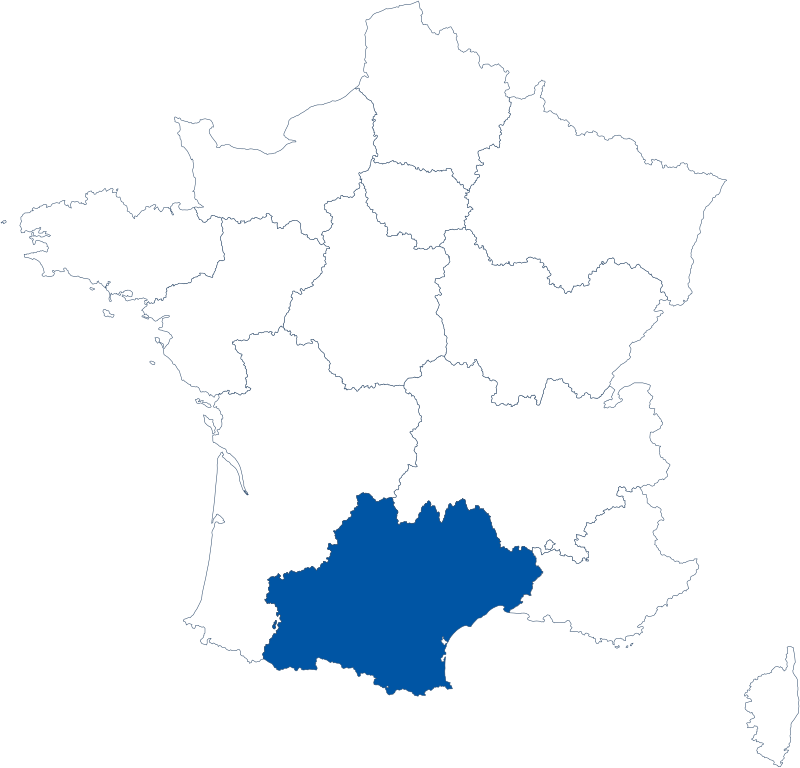
820 English-speaking jobs in Occitania
26-275 Powder dampers for mitigating satellite micro-vibrations
- CNES
- Toulouse
- February 3
This PhD research focuses on developing a new type of powder damper for mitigating micro-vibrations in satellites. The project will involve developing a dynamic model, characterizing the damper through vibration tests, and optimizing its design for maximum energy dissipation.
26-085 Vision Physical and Geometric Fondation Models for Autonomous Navigation
- CNES
- Toulouse
- February 2
This PhD thesis develops a hybrid navigation pipeline combining visual/inertial SLAM, physics- and geometry-grounded Vision Foundation Models, and 3D reconstruction techniques. The project aims to create robust navigation methods for complex environments, validated in simulations and on real robotic platforms.
26-223 Molecular Contamination in Space Environment: UV and Photofixation
- CNES
- Toulouse
- February 2
This thesis investigates the impact of UV radiation on contaminant morphology through photofixation. The research aims to identify the chemical species involved in UV-contaminant interactions and establish a protocol to characterize these reactions.
26-108 Advanced Water Recycling for Space Missions
- CNES
- Toulouse
- February 2
CNES is developing a sustainable water recycling system for space missions using photocatalytic degradation and in situ reactive oxygen nitrogen species (RONS) generation. The system integrates iron oxide nanoparticles and plasma-generated hydrogen peroxide to degrade organic and inorganic pollutants in wastewater.
26-076 Reliability Quantification and Improvement in Antenna Measurements
- CNES
- Toulouse
- February 2
This PhD research aims to improve the reliability of antenna measurements by developing new methods for assessing far-field patterns from raw data and quantifying uncorrectable uncertainties. The research will explore narrow-band delay-based models, wavelet-based deconvolution, and stochastic methods to address challenges related to spurious scatterings and environmental randomness.
26-233 Defects Identification inducing DC-RTS due to irradiation
- CNES
- Toulouse
- February 2
PhD research focused on understanding and identifying defects in irradiated silicon detectors that cause Dark Current Random Telegraph Signal (DC-RTS), leading to image degradation in space applications.
26-100 Improving Internal tides detection and characterization (SWOT, Ocolor)
- CNES
- Toulouse
- February 2
This PhD analyzes the dynamics of internal tides (ITs), focusing on high modes and solitons, and their interactions with mesoscale circulation. The goal is to develop an AI-based method for automatic IT detection in SWOT and ocean color data to improve chlorophyll mapping.
26-096 Silicon Front-End at 183/325 GHz for miniaturized space radiometers
- CNES
- Toulouse
- February 2
This research explores the potential of silicon-based front-end circuits operating at 183 GHz and 325 GHz for miniaturized space radiometers. The study aims to address challenges such as lower electron mobility and substrate losses in silicon technologies compared to III-V semiconductors.
26-040 Development of a reduced-order model of the Earth's radiation belts
- CNES
- Toulouse
- February 2
This thesis focuses on developing a reduced-order model for the Salammbô 3D electrons code, used to simulate Earth's radiation belts. The research will explore dimensionality reduction, dynamic modeling in latent space, and the impact of dimensionality reduction on model accuracy.
26-187 Thermosphere density forecast model using AI and data assimilation
- CNES
- Toulouse
- February 2
This research position focuses on improving the accuracy and capabilities of DTM_nrt, an AI-based thermosphere density forecast model. The successful candidate will investigate model limitations, explore data assimilation techniques, and develop enhancements to the model's performance.
26-006 Contribution of remote sensing to hydrological modeling optimization
- CNES
- Toulouse
- February 2
This PhD thesis investigates the use of remote sensing data to improve hydrological modeling. The research will focus on optimizing a semi-distributed GR model using various remote sensing products, including snow cover, soil moisture, evapotranspiration, and water levels. The goal is to enhance model parameterization, improve consistency between simulated variables and observations, and increase the model's spatial and temporal transferability.
26-213 Microphysics study of triboelectric charging of dust grains on Mars
- CNES
- Toulouse
- February 2
This PhD research will investigate the microphysics of triboelectric charging of dust grains on Mars. The study will combine experimental, theoretical, and numerical approaches to understand how charge is exchanged during grain-grain collisions and how ambient conditions influence these exchanges. Results will be compared with in situ data from the SuperCam instrument on the Perseverance rover.
26-052 Robust attitude control design & validation applied to balloon pointing
- CNES
- Toulouse
- February 2
This doctoral project focuses on designing robust attitude control laws for balloon-borne pointing systems. The work will involve developing control techniques that address system uncertainties and actuator limitations, including online adaptation strategies and control allocation schemes. Validation will include robustness analysis and experimental testing on a CNES test-bench.
26-008 Defect-Based Method for Predicting the Fatigue Life of Metal L-PBF Parts
- CNES
- Toulouse
- February 2
This PhD research aims to develop a method for predicting the fatigue life of metal parts produced by L-PBF additive manufacturing, considering the influence of defects. The research will involve developing a two-scale approach linking a local model detailing defects to a large-scale model of the assembled structure.
26-196 Numerical modeling of transition from multipactor effect to RF discharge
- CNES
- Toulouse
- February 2
This PhD research aims to develop a numerical model predicting the transition from multipactor to RF discharge inception in high-frequency and radio-frequency payloads. The work will investigate electron avalanche processes, gas ionization dynamics, and the influence of geometry and material properties.
26-003 Calibration of a multi-head particle detector with machine learning
- CNES
- Toulouse
- February 2
Develop a machine learning model to predict the in-flight response of a multi-head particle detector based on ground calibration data. The model will account for instrumental effects and background noise, enabling systematic calibration and intercalibration between detectors.
26-029 Physics-Constrained Deep Learning for BIOMASS Mission Forest Monitoring
- CNES
- Montpellier
- February 2
This PhD project develops physics-constrained deep learning algorithms for BIOMASS P-band SAR tomography applications. The research integrates electromagnetic scattering principles into neural network architectures to achieve accurate forest structure reconstruction.
26-215 Multisensor/method fusion to estimate bathymetry and intrinsic certainty
- CNES
- Toulouse
- February 2
This research project focuses on developing a multi-sensor fusion approach to estimate bathymetry and associated uncertainty. The project will integrate existing methods, develop new agile methods for various sensors, and incorporate uncertainty estimation for fusion. The goal is to create a new global atlas of bathymetric data.
26-044 Robust Collision Probability Assessment with Parametric Uncertainties
- CNES
- Toulouse
- February 2
This thesis develops a probabilistic framework for collision risk assessment in space, addressing uncertainties in covariance matrices, Time of Closest Approach, and nonlinear dynamics.
26-071 COSMOS - Crop Optim. in Space w/ ML & Offline computation of Strategies
- CNES
- Toulouse
- February 2
This thesis develops AI tools to optimize plant cultivation in closed-loop life support systems for space missions. It focuses on using machine learning and computer vision to estimate plant and environmental states, and reinforcement learning to compute autonomous cultivation strategies.