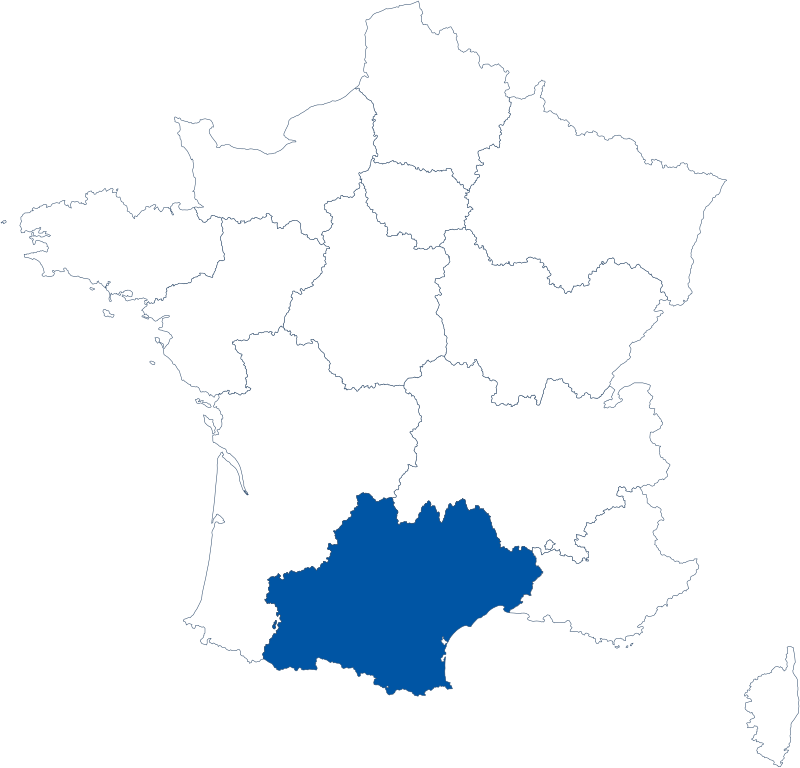
831 English-speaking jobs in Occitania

  • CNES
  • Toulouse
  • February 2
This doctoral project focuses on designing robust attitude control laws for balloon-borne pointing systems. The work will involve developing control techniques that address system uncertainties and actuator limitations, including online adaptation strategies and control allocation schemes. Validation will include robustness analysis and experimental testing on a CNES test-bench.
  • CNES
  • Toulouse
  • February 2
This research position focuses on improving the accuracy and capabilities of DTM_nrt, an AI-based thermosphere density forecast model. The successful candidate will investigate model limitations, explore data assimilation techniques, and develop enhancements to the model's performance.
  • CNES
  • Toulouse
  • February 2
This PhD research develops robust models of four-wheeled rovers for dynamic behavior, aiming to increase cruising speed to five meters per second. The research integrates structural characteristics, damping, control, and interface capabilities with emerging technologies.
  • CNES
  • Toulouse
  • February 2
This PhD analyzes the dynamics of internal tides (ITs), focusing on high modes and solitons, and their interactions with mesoscale circulation. The goal is to develop an AI-based method for automatic IT detection in SWOT and ocean color data to improve chlorophyll mapping.
  • CNES
  • Toulouse
  • February 2
This research project focuses on developing a multi-sensor fusion approach to estimate bathymetry and associated uncertainty. The project will integrate existing methods, develop new agile methods for various sensors, and incorporate uncertainty estimation for fusion. The goal is to create a new global atlas of bathymetric data.
  • CNES
  • Montpellier
  • February 2
This PhD project investigates the impact of blue economy interventions (marine protected areas, mariculture, eco-tourism) on poverty and outmigration in coastal villages of Madagascar. Using satellite imagery, AI algorithms, and statistical methods, the research will assess the causal link between blue economy development and socioeconomic outcomes over a 20-year period.
  • CNES
  • Montpellier
  • February 2
This PhD project develops physics-constrained deep learning algorithms for BIOMASS P-band SAR tomography applications. The research integrates electromagnetic scattering principles into neural network architectures to achieve accurate forest structure reconstruction.
  • CNES
  • Toulouse
  • February 2
This PhD research focuses on developing and validating numerical models to study the effects of water injection on the acoustic and thermal environment during rocket launch. The work will involve multi-phase flow modeling, acoustic and thermal simulations, and comparisons with experimental data from the MARTEL test bench.
  • CNES
  • Toulouse
  • February 2
This thesis investigates the impact of UV radiation on contaminant morphology through photofixation. The research aims to identify the chemical species involved in UV-contaminant interactions and establish a protocol to characterize these reactions.
  • CNES
  • Toulouse
  • February 2
This research explores the potential of silicon-based front-end circuits operating at 183 GHz and 325 GHz for miniaturized space radiometers. The study aims to address challenges such as lower electron mobility and substrate losses in silicon technologies compared to III-V semiconductors.
  • CNES
  • Toulouse
  • February 2
PhD research focused on understanding and identifying defects in irradiated silicon detectors that cause Dark Current Random Telegraph Signal (DC-RTS), leading to image degradation in space applications.
  • CNES
  • Toulouse
  • February 2
This thesis develops a probabilistic framework for collision risk assessment in space, addressing uncertainties in covariance matrices, Time of Closest Approach, and nonlinear dynamics.
  • CNES
  • Toulouse
  • February 2
This PhD research aims to develop a numerical model predicting the transition from multipactor to RF discharge inception in high-frequency and radio-frequency payloads. The work will investigate electron avalanche processes, gas ionization dynamics, and the influence of geometry and material properties.
  • CNES
  • Toulouse
  • February 2
This PhD research will investigate the microphysics of triboelectric charging of dust grains on Mars. The study will combine experimental, theoretical, and numerical approaches to understand how charge is exchanged during grain-grain collisions and how ambient conditions influence these exchanges. Results will be compared with in situ data from the SuperCam instrument on the Perseverance rover.
  • CNES
  • Toulouse
  • February 2
This PhD research aims to characterize the radar cross section (RCS) of electric thruster plasma plumes. The work will involve numerical simulation using a multi-physics tool, development of advanced signal processing techniques for RCS measurement in reverberant environments, and experimental characterization in both anechoic and reverberant chambers.
  • CNES
  • Toulouse
  • February 2
This PhD thesis develops a hybrid navigation pipeline combining visual/inertial SLAM, physics- and geometry-grounded Vision Foundation Models, and 3D reconstruction techniques. The project aims to create robust navigation methods for complex environments, validated in simulations and on real robotic platforms.
  • CNES
  • Toulouse
  • February 2
This PhD thesis investigates the use of remote sensing data to improve hydrological modeling. The research will focus on optimizing a semi-distributed GR model using various remote sensing products, including snow cover, soil moisture, evapotranspiration, and water levels. The goal is to enhance model parameterization, improve consistency between simulated variables and observations, and increase the model's spatial and temporal transferability.
  • CNES
  • Toulouse
  • February 2
This thesis focuses on developing a reduced-order model for the Salammbô 3D electrons code, used to simulate Earth's radiation belts. The research will explore dimensionality reduction, dynamic modeling in latent space, and the impact of dimensionality reduction on model accuracy.
  • CNES
  • Toulouse
  • February 2
This PhD study investigates the impact of high-energy radiation on spacecraft components and characterizes electrostatic discharges on critical elements. The research involves experimental, instrumental, and numerical methods to identify and measure discharges under simulated space conditions.
  • CNES
  • Toulouse
  • February 2
Develop a machine learning model to predict the in-flight response of a multi-head particle detector based on ground calibration data. The model will account for instrumental effects and background noise, enabling systematic calibration and intercalibration between detectors.
Email me future jobs like these:
next page