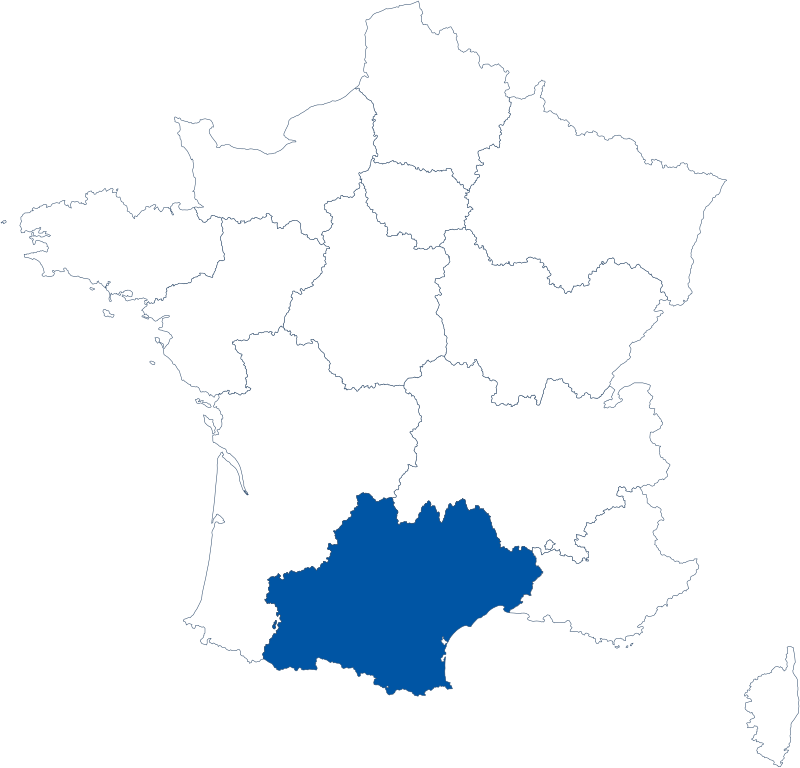
229 English-speaking jobs in Occitania
Engineering Quality Manager for Flight Control System developments (M/F)
- Airbus Operations SAS
- Toulouse
- October 7
Engineering Quality Manager for Flight Control System developments. Ensure high quality in engineering projects, improving Design Right First Time. Coach teams, conduct reviews, and manage risks for embedded software development.
Systems Business Quality Manager - Data Specialist (m/f)
- Airbus Operations SAS
- Toulouse
- October 7
Systems Business Quality Manager - Data Specialist joins the Quality Engineering team. Analyze processes, design AI solutions for automation, and facilitate data-driven problem solving in embedded systems validation. Requires engineering/data analysis background and Python proficiency.
Systems Business Quality Manager - Data Specialist (m/f)
- Airbus
- Balma
- October 7
Systems Business Quality Manager - Data Specialist joins the Quality Engineering team. Analyze processes, design AI solutions for automation, and facilitate data-driven problem solving in systems development. Requires engineering/data analysis background and Python proficiency.
Engineering Quality Manager for Flight Control System developments (M/F)
- Airbus Operations SAS
- Upper Garonne
- October 7
 Engineering Quality Manager for Flight Control System developments ensures high quality in engineering projects. This role coaches teams, conducts Process Assurance Reviews, and facilitates risk management for embedded software development.
FAL A350 Industrial Manager (f/m)
- Airbus Operations SAS
- Upper Garonne
- October 7
Lead industrialization and configuration control for the A350 final assembly line. Manage modification implementation, identify configuration deltas, and coordinate cross-functional teams to ensure product conformity and on-time delivery.Systems Business Quality Manager - Data Specialist (m/f)
- Airbus Operations SAS
- Upper Garonne
- October 7
Systems Business Quality Manager - Data Specialist joins the Quality Engineering team. Analyze processes, design AI solutions, and facilitate data-driven problem solving in embedded systems validation. Requires engineering/data analysis background and Python proficiency.FAL A350 Industrial Manager (f/m)
- Airbus
- Portet-sur-Garonne
- October 7
FAL A350 Industrial Manager leads industrialization and configuration control on the A350 final assembly line. Responsibilities include managing modification implementation and driving manufacturing optimization. Requires experience in industrial manufacturing or configuration management.
Systems Business Quality Manager - Data Specialist (m/f)
- Airbus
- Fonsorbes
- October 7
Systems Business Quality Manager - Data Specialist joins the Quality Engineering team. Analyze processes, design AI solutions for automation, and facilitate data-driven problem solving in systems development. Requires engineering/data analysis background and Python proficiency.
Human and Organisational Factors (HOF) Specialist inRobotics (f/m)...
- Airbus
- Blagnac
- October 7
HOF Specialist in Robotics contributes to production efficiency and safety by leading human factors studies for robotics and industrial machines. Requires 10+ years of HOF experience in regulated industries.
ARP Value Management Office Lead (m/f) (H/F)
- AIRBUS SAS
- Toulouse
- October 6
Lead the ARP Value Management Office within the Digital for Operation Department. This role involves driving industrial ecosystem transformation, bridging digital and physical operations, and structuring Lean governance to ensure business value delivery.
End-to-End System Lead Engineer (m/f)
- Prestwick Aerosystems
- Toulouse
- October 5
End-to-End System Lead Engineer for the OneSat Program. Responsibilities include leading engineering activities, managing system requirements, defining architecture, and interfacing with customers. Requires 5+ years in satellite telecommunications engineering.
Aftermarket Supplier Account Manager - Equipment & Systems M/F
- Prestwick Aerosystems
- Toulouse
- October 5
Manage supplier relationships for Equipment & Systems in the aftermarket. Negotiate support conditions, act on escalations, and drive supplier performance. Requires 7+ years of experience and fluency in English.
Patent Attorney Physics/Electronics/Avionics/Computer Science (D/F/H)
- Prestwick Aerosystems
- Goyrans
- October 5
Patent Attorney needed for Physics/Electronics/Avionics/Computer Science. Manage a diverse patent portfolio, lead drafting/filing, and provide strategic legal advice to protect Airbus innovations. Requires EPA or CEIPI qualification and 5+ years of IP experience.
Engineering Quality Manager for Flight Control System developments (M/F)
- Prestwick Aerosystems
- Goyrans
- October 5
Engineering Quality Manager for Flight Control System developments ensures high quality in engineering projects. This role involves coaching teams, conducting Process Assurance Reviews, and facilitating risk management for embedded software development.
ERP Specialist Manufacturing S/4 M/F
- Prestwick Aerosystems
- Blagnac
- October 5
ERP Solution Owner for Manufacturing S/4 at Airbus. Lead workshops to transform shop-floor requirements into E2E Supply Chain processes. Requires Master's degree and 10+ years in regulated industry, with 8+ in ERP deployment and SAP S/4HANA expertise.
VDI Solution Architect H/F
- Prestwick Aerosystems
- Toulouse
- October 5
Design, integrate, and implement IT solutions as a VDI Solution Architect. Act as SME for VDI and NetScaler technology, ensuring high availability and automation across on-premise and cloud environments.
ERP Solution manager - Migration strategist M/F
- Prestwick Aerosystems
- Blagnac
- October 5
Drive global ERP migration strategies, specifically S/4HANA, transforming the industrial digital ecosystem. Architect and deliver tailored migration plans while managing complex operational issues. Requires 10+ years in regulated industries with ERP deployment expertise.
ERP Logistics Manager M/F
- Prestwick Aerosystems
- Blagnac
- October 5
ERP Logistics Manager to translate industrial needs into Agile Epics, mediating between SAP logic and aerospace logistics demands. Requires 10+ years in complex industries and 8+ years mastering SAP S/4HANA.
ERP Planning & Supply Specialist S/4 M/F
- Prestwick Aerosystems
- Blagnac
- October 5
Lead workshops to translate operational needs into E2E Supply Chain processes. Spearhead Planning & Supply product definition in S/4HANA. Requires 10+ years in complex industries and 8+ years mastering SAP S/4HANA (PP, PM, MM, SD).
Digital & Business Architect - ERP Transformation (H/M)
- Prestwick Aerosystems
- Blagnac
- October 5
Define and structure Business Architecture for ERP transformation. Establish Architecture Authority, design target functional architecture, and guide strategic technology choices using ERP, PLM, and CRM knowledge.
Occitania
Occitanie