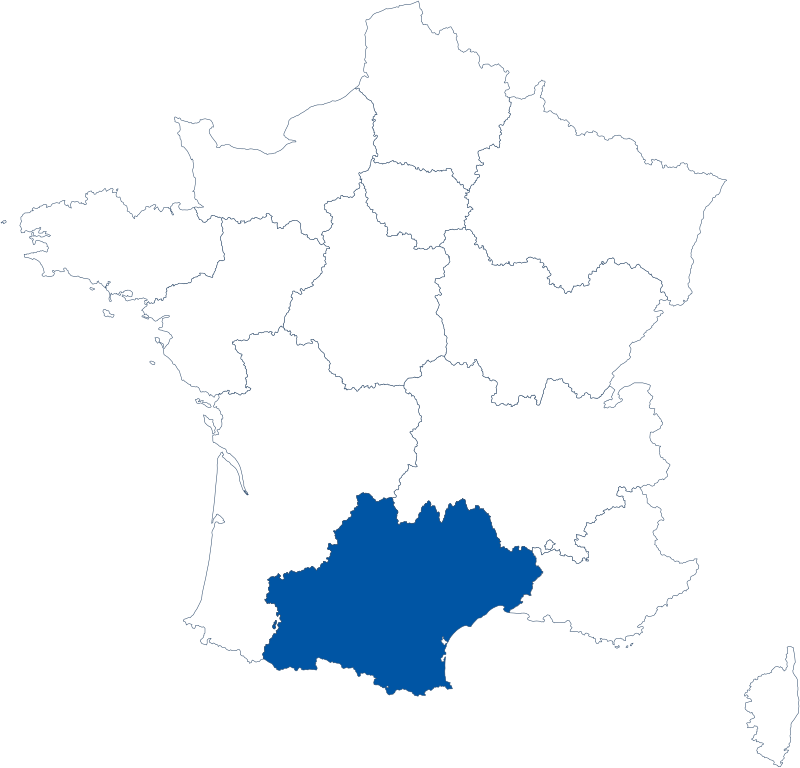
111 English-speaking jobs in Occitania
Data Steward/BA
- Pierre Fabre Group
- Toulouse
- October 14
 Data Steward/BA ensures data quality, consistency, and governance for R&D data assets. Responsibilities include maintaining glossaries, monitoring KPIs, and supporting data platform initiatives. Requires a Master's/PhD and experience in data governance or analysis.
Analog / RF & mmWave Principal Test Engineer
- NXP Semiconductors
- toulouse
- October 12
Senior Principal Test Engineer to develop industrial test solutions (hardware and software) for mass production of Automotive Radar products. Requires 10+ years of Analog, RF/mmW test development experience using ATE systems.
Chief Production Officer
- Darwin Recruitment
- toulouse
- October 12
Chief Production Officer to partner with the CEO to execute production strategy. Lead end-to-end space systems production, driving operational excellence and compliance. Requires 20+ years in aerospace and managing large teams.
Backend Engineer - Mission Operations Services
- Loft Orbital
- toulouse
- October 11
Backend Engineer to build and scale microservices for satellite fleet command and monitoring. Requires 4+ years of production backend experience, solid Python skills, and experience with Docker and API design.
EMC Design Engineer
- NXP Semiconductors
- toulouse
- October 10
EMC Design Engineer develops on-chip EMC solutions for next-gen semiconductors. Responsibilities include modeling, simulation, validation, and silicon debugging while balancing performance, reliability, area, and cost. Requires a Master's or Ph.D. in a relevant engineering field.
Juriste - Stage H/F
- Pierre Fabre Group
- Toulouse
- October 9
- student
Legal intern role requiring a Master 2 in Business/International Law. Responsibilities include advising on legal questions, drafting agreements, and certifying operational feasibility. Must be proficient in English and Office suite.Payload Field Engineer, Spacecraft Programmes
- SES Latin America
- Toulouse
- October 7
 Provide resident payload engineering support for satellite procurement programs, overseeing Design, Assembly, Integration, and Launch. Review test data, ensure specification compliance, and manage anomaly investigations in a governmental/military context.
Chargé(e) de modélisation et simulation PK/PD en oncologie - Stage H/F
- Pierre Fabre Group
- Toulouse
- October 6
- student
- no experience
Master's student role in oncology PK/PD modeling and simulation. Analyze datasets, develop quantitative models (PK/PD, TGI, PBPK), and perform simulations. Requires R/Python skills and knowledge of PK/PD basics.Principal Digital Design Engineer
- NXP Semiconductors
- toulouse
- October 6
Principal Digital Design Engineer to lead the design, implementation, and support of in-vehicle networking transceivers. Responsibilities include defining architecture, optimizing design, and implementing in SystemVerilog or Chisel.
Clinical Scientist - R&D Pharma F/M
- Pierre Fabre Group
- Toulouse
- October 6
Clinical Scientist in R&D Pharma to support clinical trial development in oncology. Responsibilities include data review, study document contribution, and collaborating on program rationale. Requires advanced degree and 3 years of Pharma R&D experience.Ingeniero/a de software y plataformas
- GMV
- Ramonville-Saint-Agne
- October 6
 Software and Platform Engineer to develop, integrate, and maintain navigation systems for ERAS and RLSP. Requires C++ and Python skills, experience with Linux, Kubernetes, and monitoring tools.
Technical Program Manager, Customer Delivery
- Loft Orbital
- toulouse
- October 4
Own Mission Development Plans and manage the Customer Offering Portfolio to connect product development to customer value. Drive cross-functional coordination and engage with customers on mission scope and tradeoffs.
Onboard Software Engineer
- Loft Orbital
- toulouse
- October 4
Design and implement robust onboard software for spacecraft, focusing on monitoring and control. Requires 5+ years of experience with C/C++ and Python, Git, and distributed architecture.
Onboard Software Engineer - Peripheral Services
- Loft Orbital
- toulouse
- October 4
Develop software integrating third-party devices into the satellite platform. Requires 3+ years of experience with C/C++ and Python, Git, and distributed architecture knowledge.
Multilingual Customer Support
- Cross Border Talents
- Toulouse
- October 3
 Provide customer support for international brands in a remote or on-site role. Fluency in German, Dutch, Danish, Finnish, Norwegian, French, Italian, Spanish, Portuguese, Greek, Croatian, Czech, Flemish, Slovak, Slovenian, Polish, Irish, Estonian, Lithuanian, Latvian, Icelandic, and English is required.
Flight Instructor Single Engine Piston (f/m/d)
- CAE
- Montpellier
- October 3
 Seeking a Flight Instructor for Single Engine Piston. Responsibilities include performing flight training in aircraft and simulators, maintaining records, and participating in training reviews. Requires EASA CPL (A) with SEP/IR and FI (A) rating.
Manager - Project Execution - Digital Energy (BMS/EPMS) F/H
- Schneider Electric
- lattes
- October 2
Lead project execution for Digital Energy (BMS/EPMS) for strategic accounts. Direct a regional team, manage budgets, risks, and ensure safe, profitable delivery from initiation to site acceptance. Requires 10+ years of project management experience.
Space Systems Engineer
- Darwin Recruitment
- toulouse
- October 1
Systems Engineer role requiring 3-5 years of experience in aerospace or complex engineering. Responsibilities include planning engineering activities, managing technical schedules, tracking project progress, and coordinating cross-disciplinary teams. Requires a relevant degree and strong systems engineering knowledge.
Project Management Officer
- Pangea Propulsion
- Toulouse
- September 30
- no experience
 Support Project Managers in daily execution, portfolio planning, and performance monitoring for advanced space propulsion systems. Contribute to process modernization and digital tool adoption.
Senior Software Engineer
- Swile
- montpellier
- September 29
Senior Software Engineer role focused on creatively solving business and engineering challenges. Responsibilities include designing, developing, testing, and monitoring code autonomously while mentoring team growth.
Occitania
Occitanie