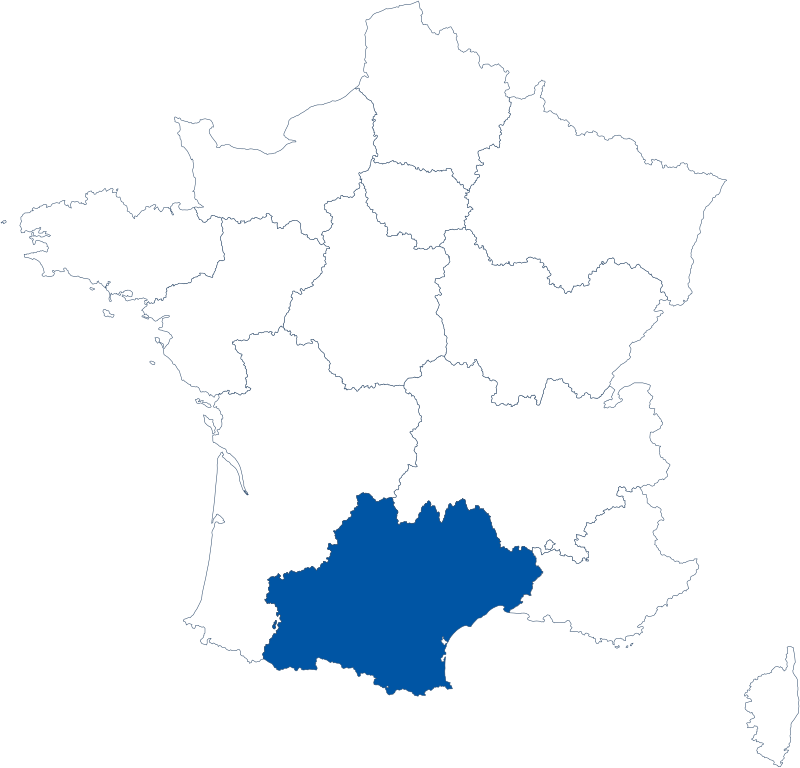
114 English-speaking jobs in Occitania
Propulsion Test Team Leader
- Darwin Recruitment
- toulouse
- October 27
Propulsion Test Team Leader to co-lead rocket engine design, drive performance improvements, and develop new concepts for full-scale launcher development. Requires aerospace Master's and 3+ years of relevant experience.
Lead GNC/AOCS Engineer
- Darwin Recruitment
- toulouse
- October 27
Lead GNC/AOCS Engineer to define specifications, design, and analyze AOCS subsystems. Responsibilities include performance calculations, component qualification, leading testing, and supporting operations. Requires space engineering degree and 3+ years in AOCS.
Principal Analog Design Engineer - BMS Production Support
- NXP Semiconductors
- toulouse
- October 27
Principal Analog Design Engineer to support BMS products in production using SmartMOS/BCD technologies. Focus on sustaining engineering, quality/cost improvements, RMA investigations, and manufacturing support. Requires 10+ years in Analog/Mixed-Signal IC Design.
Full Stack Engineer - AI Marketplace
- Loft Orbital
- toulouse
- October 27
Founding Full Stack Engineer for an AI Marketplace. Build storefront, partner portal, and APIs using TypeScript/React/Vue and Python, Go, or Node. Must have 4+ years shipping full-stack products.
Harness Design Engineer
- Loft Orbital
- toulouse
- October 27
- no experience
Design electrical harnesses for spacecraft, payloads, and test systems. Translate schematics and ICD's into harness designs using Creo. Requires a degree in electrical or aerospace engineering and strong electrical foundation.
International Business Developer Microsoft Dynamics 365 Business Central H/F
- Absys Cyborg
- toulouse
- October 27
International Business Developer to drive growth in the International Enterprise Business Applications market. Responsibilities include prospecting, designing commercial strategies, and developing sales pipelines for Microsoft Dynamics 365 Business Central.
Patent Attorney (Mechanics) (m/f/d)
- Connexion Emploi
- toulouse
- October 27
Patent Attorney (Mechanics) to lead drafting, filing, and prosecution of patent applications. Manage a broad portfolio, conduct cross-examinations, and provide expert IP advice. Requires CEIPI qualification and 5+ years of IP experience.
Certification Specialist (m/f/d)
- Connexion Emploi
- toulouse
- October 27
Certification Specialist defines and negotiates Certification Plans with airworthiness authorities. This role coordinates stakeholders, manages authority interfaces, and leads continuous airworthiness assessments. Significant experience in system safety and certification is required.
Principal Analog Design Engineer - PMIC Production Support
- NXP Semiconductors
- toulouse
- October 24
Principal Analog Design Engineer supports PMIC production using SmartMOS/BCD technologies. Responsibilities include sustaining engineering, quality/cost improvements, manufacturing support, and customer return investigations. Requires 5+ years in Analog/Mixed-Signal IC Design and Cadence proficiency.
Senior Analog Design Engineer - PMIC Production Support
- NXP Semiconductors
- toulouse
- October 24
Senior Analog Design Engineer to support PMIC products in production using SmartMOS/BCD technologies. Responsibilities include sustaining engineering, quality/cost improvements, and customer return investigations. Requires 5+ years in Analog/Mixed-Signal IC Design and Cadence proficiency.
Late Phase Statistician - Clinical Development
- Pierre Fabre Group
- Toulouse
- October 22
 Senior Statistician needed for late-phase clinical development, focusing on Phase IIb and III randomized controlled trials. Requires 6+ years of experience, expertise in estimands, confirmatory testing, and regulatory submissions. Proficiency in SAS or R is required.
Senior Quantitative Clinical Pharmacology Lead H/F
- Pierre Fabre Group
- Toulouse
- October 22
Senior Quantitative Clinical Pharmacology Lead drives MIDD strategy and clinical pharmacology plans from pre-IND to approval. Expertise in oncology, rare disease, and leading cross-functional teams is required.Safety Architect - AI Tools
- NXP Semiconductors
- toulouse
- October 22
Safety Architect for AI Tools helps make AI-based systems safe and certifiable. This role applies AI safety standards to identify risks and develops solutions, focusing on AI alignment, interpretability, and robustness.
Acheteur(euse) IT - Stage H/F
- Pierre Fabre Group
- Albi
- October 22
- student
IT Buyer Internship: Help define and execute group purchasing strategy. Analyze portfolios, optimize prices via TCO, and manage supplier negotiations and performance. Requires Bac + 5 in purchasing or IT.Senior Computational Chemist, Platform Development F/M
- Pierre Fabre Group
- Toulouse
- October 20
Senior Computational Chemist develops and deploys reproducible computational chemistry workflows on AWS for small-molecule discovery. Expertise includes AI/ML, docking, molecular dynamics, and Python.System and Hardware Safety Architect
- NXP Semiconductors
- toulouse
- October 20
Develop innovative safety solutions for automotive, industrial, and robotics systems as a System and Hardware Safety Architect. Define safety concepts compliant with ISO 26262 and IEC 61508, focusing on 48V SDV architectures and X-by-Wire systems.
Creative Strategist (YouTube Ads)
- TechBiz Global GmbH
- Montpellier
- October 20
 Creative Strategist needed to develop and script direct response YouTube ads and mini VSLs for e-commerce. Responsibilities include research, angle development, and iterating based on performance data. Requires 2+ years writing direct response video ads.
Project Functional Safety manager
- NXP Semiconductors
- toulouse
- October 19
Project Functional Safety Manager responsible for defining and executing the product safety lifecycle per ISO26262. Requires 5+ years in Automotive Functional Safety management and experience with safety work products.
Manutentionnaire
- FedEx
- Colomiers
- October 16
- warehouse
This role is for a Manutentionnaire position involving 100% handling duties. The schedule includes specific evening and late shifts Monday through Friday, with Saturday work and Sunday off.
Data Steward/BA
- Pierre Fabre Group
- Toulouse
- October 14
Data Steward/BA ensures data quality, consistency, and governance for R&D data assets. Responsibilities include maintaining glossaries, monitoring KPIs, and supporting data platform initiatives. Requires a Master's/PhD and experience in data governance or analysis.Occitania
Occitanie