83 English-speaking jobs in Toulouse
Data Steward/BA
- Pierre Fabre Group
- Toulouse
- October 14
 Data Steward/BA ensures data quality, consistency, and governance for R&D data assets. Responsibilities include maintaining glossaries, monitoring KPIs, and supporting data platform initiatives. Requires a Master's/PhD and experience in data governance or analysis.
Embedded Linux Engineer
- RHESO.TECH
- toulouse
- October 12
Embedded Linux Engineer needed to port open-source drivers and bootloaders to new hardware. Develop Linux distributions using Yocto, OpenEmbedded, or Buildroot, and contribute to the Linux ecosystem. Requires 10+ years of experience.
Analog / RF & mmWave Principal Test Engineer
- NXP Semiconductors
- toulouse
- October 12
Senior Principal Test Engineer to develop industrial test solutions (hardware and software) for mass production of Automotive Radar products. Requires 10+ years of Analog, RF/mmW test development experience using ATE systems.
Chief Production Officer
- Darwin Recruitment
- toulouse
- October 12
Chief Production Officer to partner with the CEO to execute production strategy. Lead end-to-end space systems production, driving operational excellence and compliance. Requires 20+ years in aerospace and managing large teams.
Backend Engineer - Mission Operations Services
- Loft Orbital
- toulouse
- October 11
Backend Engineer to build and scale microservices for satellite fleet command and monitoring. Requires 4+ years of production backend experience, solid Python skills, and experience with Docker and API design.
Software and Platform Engineer
- GMV
- toulouse
- October 11
Software and Platform Engineer to support ERAS and RLSP projects. Responsibilities include development, integration, and maintenance of navigation systems using C++ and Python in Linux environments. Experience with Kubernetes, Git, and monitoring tools is required.
EMC Design Engineer
- NXP Semiconductors
- toulouse
- October 10
EMC Design Engineer develops on-chip EMC solutions for next-gen semiconductors. Responsibilities include modeling, simulation, validation, and silicon debugging while balancing performance, reliability, area, and cost. Requires a Master's or Ph.D. in a relevant engineering field.
Senior Account Executive (Hunter)
- PTC
- toulouse
- October 9
Seeking a highly motivated Senior Account Executive (Hunter) to drive new business acquisition across enterprise and commercial accounts. This role focuses on identifying, pursuing, and closing net-new opportunities in complex sales cycles.
Senior Consultant - PLM
- Infosys Technologies
- toulouse
- October 9
Senior Consultant drives design, testing, and implementation of aerospace engineering and cabin interior solutions. Acts as liaison between users, development teams, and stakeholders in a SAFe Agile environment, focusing on PLM and CAD tools.
Juriste - Stage H/F
- Pierre Fabre Group
- Toulouse
- October 9
- student
Legal intern role requiring a Master 2 in Business/International Law. Responsibilities include advising on legal questions, drafting agreements, and certifying operational feasibility. Must be proficient in English and Office suite.Manager Operational Excellence
- Evotec Group
- toulouse
- October 8
Manager, Operational Excellence drives CI methodology across manufacturing, lab, and R&D. Responsibilities include deploying tools like VSM and DMAIC, owning priority projects to verified financial outcomes, and building CI communities. Requires Lean Six Sigma Green Belt.
Babysitter
- FamilySphere
- Pin-Balma
- October 7
- part-time
 Seeking a part-time evening babysitter to provide safe, stimulating care for children. Responsibilities include supervising, engaging in age-appropriate activities, and communicating with parents. Previous childcare experience and perfect English command are required.
Payload Field Engineer, Spacecraft Programmes
- SES Latin America
- Toulouse
- October 7
 Provide resident payload engineering support for satellite procurement programs, overseeing Design, Assembly, Integration, and Launch. Review test data, ensure specification compliance, and manage anomaly investigations in a governmental/military context.
Chargé(e) de modélisation et simulation PK/PD en oncologie - Stage H/F
- Pierre Fabre Group
- Toulouse
- October 6
- student
- no experience
Master's student role in oncology PK/PD modeling and simulation. Analyze datasets, develop quantitative models (PK/PD, TGI, PBPK), and perform simulations. Requires R/Python skills and knowledge of PK/PD basics.Principal Digital Design Engineer
- NXP Semiconductors
- toulouse
- October 6
Principal Digital Design Engineer to lead the design, implementation, and support of in-vehicle networking transceivers. Responsibilities include defining architecture, optimizing design, and implementing in SystemVerilog or Chisel.
Clinical Scientist - R&D Pharma F/M
- Pierre Fabre Group
- Toulouse
- October 6
Clinical Scientist in R&D Pharma to support clinical trial development in oncology. Responsibilities include data review, study document contribution, and collaborating on program rationale. Requires advanced degree and 3 years of Pharma R&D experience.Ingeniero/a de software y plataformas
- GMV
- Ramonville-Saint-Agne
- October 6
 Software and Platform Engineer to develop, integrate, and maintain navigation systems for ERAS and RLSP. Requires C++ and Python skills, experience with Linux, Kubernetes, and monitoring tools.
Technical Program Manager, Customer Delivery
- Loft Orbital
- toulouse
- October 4
Own Mission Development Plans and manage the Customer Offering Portfolio to connect product development to customer value. Drive cross-functional coordination and engage with customers on mission scope and tradeoffs.
Onboard Software Engineer
- Loft Orbital
- toulouse
- October 4
Design and implement robust onboard software for spacecraft, focusing on monitoring and control. Requires 5+ years of experience with C/C++ and Python, Git, and distributed architecture.
Onboard Software Engineer - Peripheral Services
- Loft Orbital
- toulouse
- October 4
Develop software integrating third-party devices into the satellite platform. Requires 3+ years of experience with C/C++ and Python, Git, and distributed architecture knowledge.
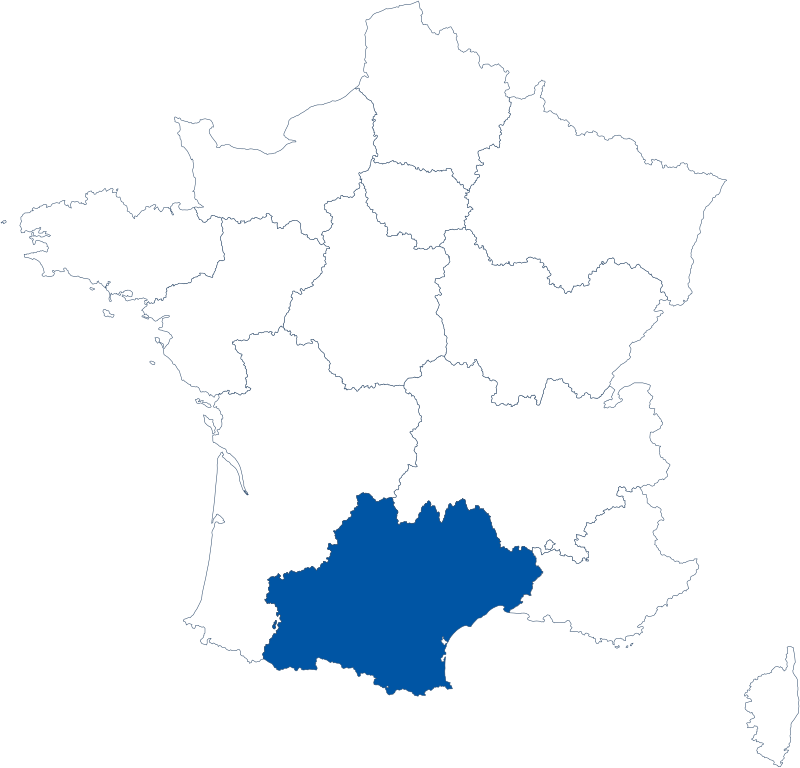
Toulouse

Other Cities
- 1643Paris

- 226Nanterre

- 132Lyon

- 97Boulogne-Billancourt

- 55Cannes - Crasse

- 54Grenoble

- 44Lille

- 40Saint-Denis

- 38Bordeaux

- 31Nantes

- 31Rennes

- 29Nice

- 28Strasbourg

- 27Aix-en-Provence

- 25Créteil

- 15Montpellier

- 13Marseille

- 11Nancy

- 7Angers

- 7Caen

- 7Saint-Étienne

- 6Reims

- 5Argenteuil

- 5Chambéry

- 5Limoges

- 4Avignon

- 4Cholet

- 4Orléans

- 3Amiens

- 3Besançon

- 3Dunkirk

- 3Le Havre

- 3Le Mans

- 3Pau

- 3Toulon

- 3Tours

- 2Brest

- 2Clermont-Ferrand

- 1Béziers

- 1La Rochelle

- 1Rouen


