86 English-speaking jobs in Toulouse
Onboard Software Engineer
- Loft Orbital
- toulouse
- October 4
Design and implement robust onboard software for spacecraft, focusing on monitoring and control. Requires 5+ years of experience with C/C++ and Python, Git, and distributed architecture.
Onboard Software Engineer - Peripheral Services
- Loft Orbital
- toulouse
- October 4
Develop software integrating third-party devices into the satellite platform. Requires 3+ years of experience with C/C++ and Python, Git, and distributed architecture knowledge.
Multilingual Opportunities
- Cross Border Talents
- Toulouse
- October 4
 Recruiting Customer Support Specialists for international projects in Portugal, Greece, Spain, Malta, and Bulgaria. Fluent speakers of various languages (listed in description) and English required. Competitive salary, full-time contracts, remote and on-site opportunities, relocation package, and paid training offered.
Multilingual Customer Support
- Cross Border Talents
- Toulouse
- October 3
Provide customer support for international brands in a remote or on-site role. Fluency in German, Dutch, Danish, Finnish, Norwegian, French, Italian, Spanish, Portuguese, Greek, Croatian, Czech, Flemish, Slovak, Slovenian, Polish, Irish, Estonian, Lithuanian, Latvian, Icelandic, and English is required.Space Systems Engineer
- Darwin Recruitment
- toulouse
- October 1
Systems Engineer role requiring 3-5 years of experience in aerospace or complex engineering. Responsibilities include planning engineering activities, managing technical schedules, tracking project progress, and coordinating cross-disciplinary teams. Requires a relevant degree and strong systems engineering knowledge.
Project Management Officer
- Pangea Propulsion
- Toulouse
- September 30
- no experience
 Support Project Managers in daily execution, portfolio planning, and performance monitoring for advanced space propulsion systems. Contribute to process modernization and digital tool adoption.
Master Data Management Expert for ERP
- Airbus Group
- toulouse
- September 29
Lead SAP-centric data governance for Master Data X-Systems. Serve as SME for Material and Vendor Master Data, defining models and protocols. Implement E2E Master Data Governance using SAP MDG.
Salesforce Service Cloud developer
- TechBiz Global GmbH
- Toulouse
- September 25
 Salesforce Service Cloud Developer needed to lead design, configuration, and deployment of Service Cloud and Agentforce solutions. Requires 3+ years of experience, expertise in process design, and strong integration knowledge.
Space surveillance and Tracking Engineer
- GMV
- toulouse
- September 22
Develop state-of-the-art algorithms in Space Surveillance and Tracking. Responsibilities include collision risk assessment, orbit determination, and implementing algorithms in software modules. Aerospace engineer with space mechanics knowledge is sought.
Principal - Program Manager
- NXP Semiconductors
- toulouse
- September 22
Principal Program Manager leads complex semiconductor programs across the NPI lifecycle, ensuring on-time, on-quality, and on-cost delivery. This role drives execution for strategic segments like 48V electrification.
Satellite Systems Engineer
- Loft Orbital
- toulouse
- September 22
Satellite Systems Engineer to lead development for customer missions using flight proven buses. Serve as technical reference, ensuring end-to-end integration across hardware and software teams. Requires 5+ years as a spacecraft systems engineer.
ML Runtime Engineer
- Loft Orbital
- toulouse
- September 22
Own model compilation and performance tooling for running ML on flight hardware. Responsibilities include optimizing ONNX models for accelerators, building ground-side paths, and developing benchmarking tools. Requires strong C++ and Python skills.
End-to-end Engineering manager (m/f/d)
- Connexion Emploi
- toulouse
- September 22
End-to-end Engineering Manager for satellite telecommunications. Responsibilities include understanding customer mission needs, defining system concepts, and managing end-to-end activities. Requires 5+ years in satellite engineering.
Staff Security Engineer
- Swile
- toulouse
- September 22
Staff Security Engineer to strengthen product and platform security. This hands-on role builds security into systems, hardening applications, access controls, and designing privacy-preserving architectures. Requires strong engineering skills.
Superviseurs Des Operations
- FedEx
- Colomiers
- September 21
Superviseurs Des Operations role within FedEx, a global express transportation company. The position is part of a team committed to delivering outstanding service across 220+ countries.
Cariste Manutentionnaire Level 1
- FedEx
- Colomiers
- September 21
- warehouse
Cariste Manutentionnaire Level 1 role involving 100% handling duties. Shifts are scheduled Monday through Friday, with specific evening and early morning hours.
Product Manager
- Loft Orbital
- toulouse
- September 18
Own the product roadmap by translating customer needs and strategy into engineering requirements. Requires 7+ years of PM experience with domain knowledge in aerospace, earth observation, or embedded systems.
ESD Design Expert
- NXP Semiconductors
- toulouse
- September 17
ESD Design Expert defines and deploys advanced ESD protection solutions across product lines. This technical leader drives ESD/EMC strategies, optimizes on-chip protection for various ICs, and establishes design methodologies. Requires deep expertise in analog IC design and ESD standards.
Dermatology Project Leader F/M
- Pierre Fabre Group
- Toulouse
- September 15
 Lead dermatology drug discovery programs, shaping research strategies from early discovery through early clinical development. Requires PhD or MD/PhD with 5-10 years of pharma/biotech experience.
Ingeniero/a para vigilancia y seguimiento espacial
- GMV
- Ramonville-Saint-Agne
- September 15
 Develop state-of-the-art algorithms in Space Surveillance and Tracking. Responsibilities include developing and implementing algorithms in Space Mechanics, collision risk assessment, and orbit determination. Requires an aerospace engineer with knowledge of space mechanics.
Toulouse

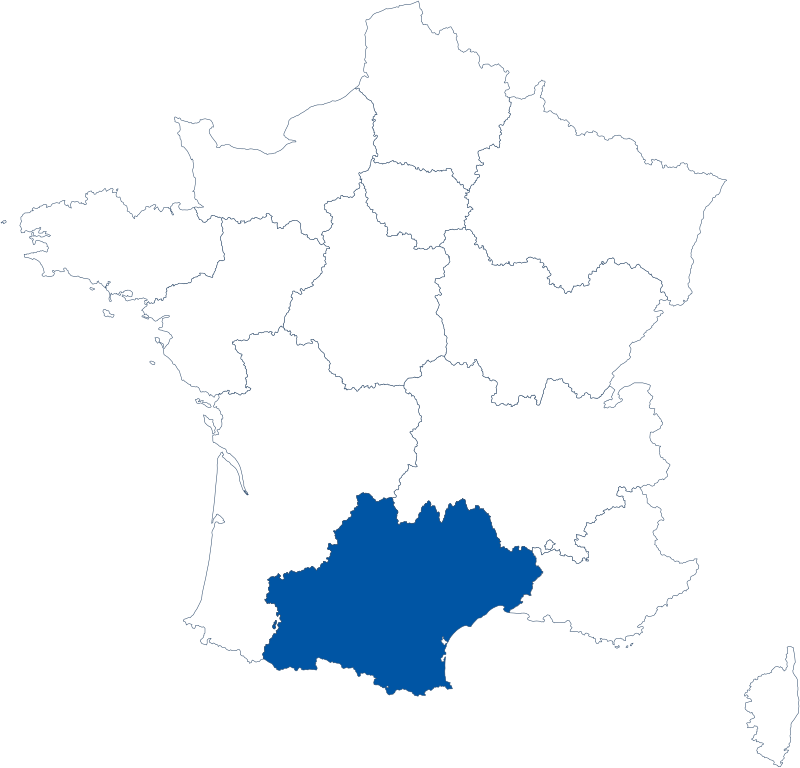
Other Cities
- 1763Paris

- 248Nanterre

- 140Lyon

- 111Boulogne-Billancourt

- 58Cannes - Crasse

- 57Grenoble

- 52Lille

- 41Bordeaux

- 41Saint-Denis

- 36Nantes

- 32Strasbourg

- 30Rennes

- 29Nice

- 28Aix-en-Provence

- 23Créteil

- 15Marseille

- 15Montpellier

- 12Nancy

- 9Angers

- 6Caen

- 6Limoges

- 6Orléans

- 6Reims

- 5Argenteuil

- 5Chambéry

- 5Cholet

- 5Le Mans

- 5Saint-Étienne

- 4Amiens

- 4Avignon

- 4Brest

- 3Besançon

- 3Dunkirk

- 3Le Havre

- 3Pau

- 3Toulon

- 3Tours

- 2Clermont-Ferrand

- 2Dijon

- 2La Rochelle

- 2Poitiers

- 2Rouen

- 1Béziers

- 1Mulhouse


